Every slide has a story
A histopathology laboratory may process hundreds—or even thousands—of tissue specimens every day. Behind every glass slide is a patient awaiting answers, a surgeon planning the next step in treatment, or a researcher working toward the next discovery.
Tissue processors, microtomes, cryostats, digital scanners and AI‑enabled image analysis often receive the most attention. Yet, one small process quietly protects the integrity of the entire diagnostic workflow: accurate slide identification.
A perfectly stained tissue section has little value if it is assigned to the wrong patient. Even the most advanced digital pathology platform depends on one fundamental requirement: the slide must be uniquely and correctly identified from the moment it is created until the final diagnosis is reported.
This is why automated slide labelling has become an essential part of modern histopathology laboratories.
What is an automated slide label printer?
An automated slide label printer is a dedicated laboratory instrument that prints high‑resolution, durable identification labels and applies them accurately to microscope slides before they enter the staining and diagnostic workflow.
Unlike handwritten labels or manually applied stickers, automated systems generate standardised, highly legible labels designed to remain readable throughout tissue processing, staining, coverslipping, long‑term storage, and digital slide scanning.
Most modern systems use thermal transfer printing technology with chemical‑resistant, heat‑resistant labels that withstand routine histology reagents and processing conditions. The result is a slide that carries its identity securely throughout its entire lifecycle.
Why does slide identification matter so much?
Every laboratory aims for diagnostic accuracy, but accuracy starts long before a pathologist looks through the microscope. It begins with traceability.
A single specimen may generate multiple tissue blocks, and each block can produce several slides. If identification is unclear or inconsistent, the laboratory faces serious risks, including:
- Misidentification of patient samples
- Repeat processing and additional costs
- Delayed reporting and longer turnaround times
- Increased administrative workload for tracking and correction
- Reduced overall laboratory efficiency
- Greater potential for diagnostic errors and risk incidents
A clearly printed, standardised label ensures that every slide remains linked to the correct patient and specimen as it moves through the histopathology workflow.
Where slide printing fits in the histopathology workflow
Many people assume slide printing is just the final step before microscopy. In reality, it forms a crucial bridge between specimen preparation and diagnostic interpretation.
A typical workflow looks like this:
- Specimen reception – Patient and specimen details are entered into the Laboratory Information System (LIS).
- Grossing – Specimens are examined, trimmed and placed into cassettes, with all identifiers recorded.
- Tissue processing – Cassettes pass through fixation, dehydration, clearing and paraffin infiltration.
- Embedding – Tissues are embedded into paraffin blocks with correct orientation.
- Microtomy – Thin sections are cut from blocks and transferred onto microscope slides.
- Automated slide labelling – Each slide receives a durable printed label containing patient identifiers, accession numbers and barcodes or QR codes.
- Slide staining & coverslipping – Labelled slides move through automated or manual staining and coverslipping.
- Digital pathology & reporting – Printed labels are read reliably by digital scanners, ensuring seamless linking with LIS and reporting systems.
At every stage, the accuracy established during slide identification supports workflow continuity, digital integration and patient safety.
From specimen to report – where labelling protects the workflow
Why laboratories are moving away from manual labelling
For many years, handwritten slide labels were considered acceptable. However, growing workloads and the adoption of automated workflows have exposed important limitations.
Manual slide labelling can lead to:
- Inconsistent or illegible handwriting
- Smudged ink and partially erased identifiers
- Time‑consuming preparation for each case
- Higher risk of transcription errors
- Limited compatibility with automated or digital workflows
Automated slide printers remove much of this variability by generating consistent, standardised labels at high speed. Consistency is no longer a convenience—it is a core requirement for quality and digital readiness.
Key advantages of automated slide printing
Modern slide printers contribute directly to laboratory performance in multiple areas:
- Improved traceability – Each slide carries clear, permanent identification from microtomy to archiving.
- Faster workflow – Automation minimises repetitive manual labelling and frees technicians for higher‑value tasks.
- Enhanced patient safety – Standardised identifiers reduce the risk of mix‑ups and mislabelled cases.
- Better digital integration – Lab‑grade barcodes and clear text support reliable digital scanning and LIS connectivity.
- Long‑term durability – Chemical‑ and heat‑resistant labels stay readable even after staining, coverslipping and storage.
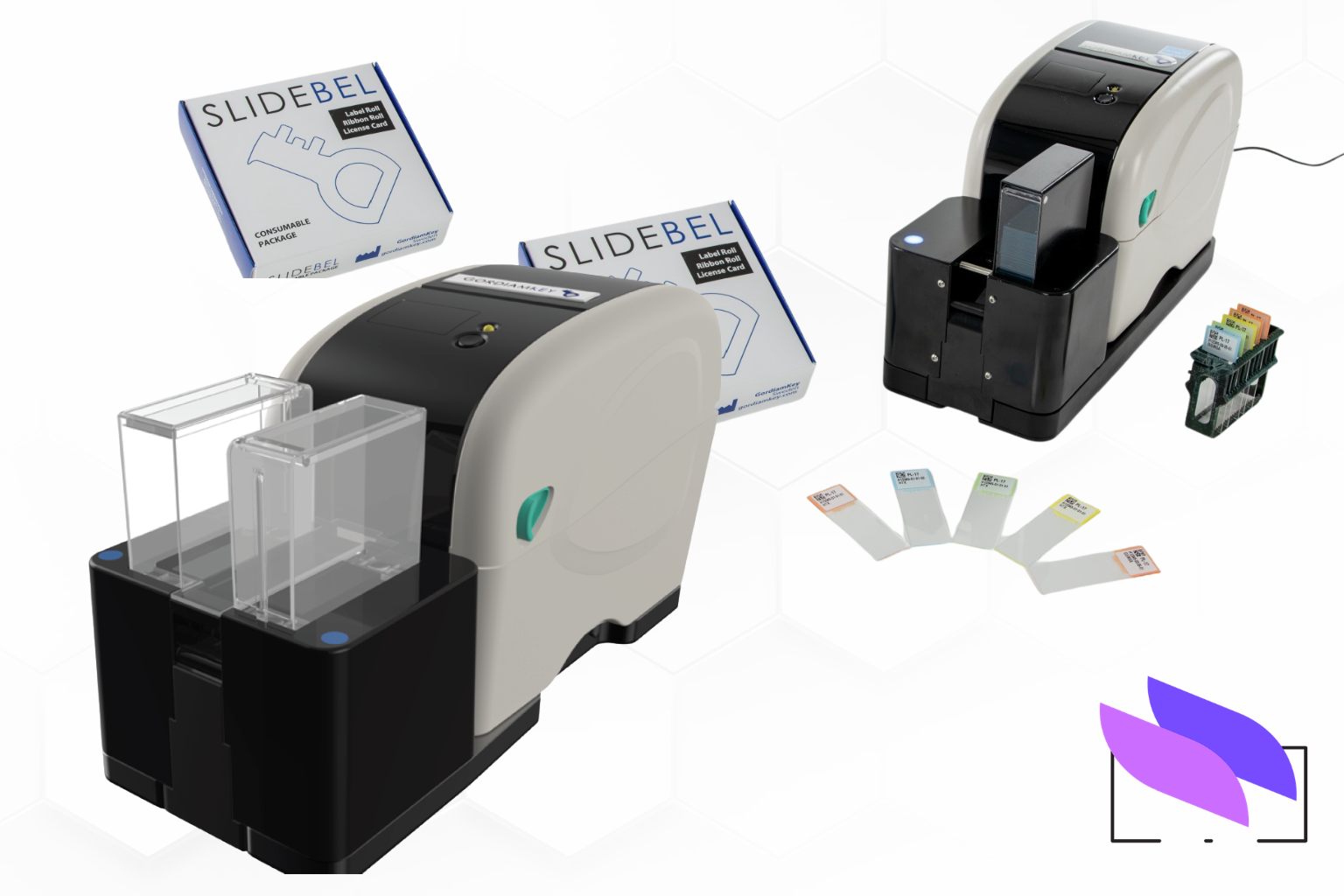
The role of SlideBel DUO in modern histopathology
As laboratories automate more of their specimen preparation, the need for dependable slide identification becomes increasingly critical. The SlideBel DUO has been engineered to simplify this step while maintaining high‑quality printing and robust performance.
Key characteristics include:
- Compatibility with virtually all standard microscope slides
- High‑resolution thermal transfer printing (up to 300 dpi)
- Durable labels resistant to routine laboratory chemicals and heat
- Compact, ergonomic design ideal for limited bench space
- Throughput of approximately 18–20 slides per minute
- USB and Ethernet connectivity for flexible deployment
- Integration with Laboratory Information Systems (LIS) via standard Windows drivers
- Optimised for downstream automated staining and digital pathology scanning workflows
Rather than acting as an isolated device, SlideBel DUO becomes an integrated component of a connected histopathology workflow—linking specimen, slide, scanner and report under one traceable identity.
Automation is about more than speed
Discussions about automation often centre on throughput—how many slides per hour, how many cases per day. While speed is important, the greatest benefit of automation is consistency.
Automated slide labelling enables:
- Standardised identification formats across the lab
- Reduced manual handling and rewriting of information
- Greater workflow reproducibility
- Simplified processes that are easier to train and audit
- Improved confidence in quality management systems
Ultimately, automation allows laboratory professionals to dedicate more time to interpretation, correlation and communication of results— the activities that matter most to patients and clinicians.
Supporting the complete histopathology workflow
Slide printing is one critical link in a larger chain. At ISTOS Medical, we view histopathology not as a collection of individual devices, but as an integrated workflow—where every workstation contributes to diagnostic quality.
Our solutions support the complete histopathology process, including:
- Grossing solutions
- Tissue processing systems
- Embedding systems
- Rotary microtomes
- Cryostats
- Automated slide printers
- Automated stainers & coverslippers
- Digital pathology solutions
When each component works together—from cassettes to slides to digital images—laboratories benefit from greater efficiency, stronger traceability and enhanced diagnostic confidence.
Looking ahead
Histopathology is rapidly moving toward fully connected, digitally integrated laboratories. Artificial intelligence, digital pathology, automation and smart information systems are reshaping how diagnostic services are delivered.
Yet none of these innovations can succeed without one essential foundation: reliable specimen identification. Every diagnosis begins with a specimen. Every specimen becomes a slide. And every slide must tell the right story.
Automated slide labelling ensures that story remains accurate from specimen receipt to final diagnosis.
Conclusion
Modern histopathology laboratories are built on precision, consistency and traceability. While tissue processors, microtomes, cryostats and digital pathology systems continue to advance diagnostic science, automated slide labelling quietly protects one of the most important aspects of laboratory quality—the identity of every patient sample.
By combining reliable printing technology with seamless workflow integration, solutions such as SlideBel DUO help laboratories improve efficiency, support digital transformation and strengthen confidence in every diagnosis.
At ISTOS Medical, we are committed to delivering histopathology solutions that help laboratories work smarter, safer and with greater precision—because every slide matters, and every patient deserves diagnostic confidence.
Learn more about histopathology solutions from ISTOS Medical at www.istosmedical.com .